

Source Code vs Custom App Development Cost Malaysia: What Is Cheaper?
A source code solution is not automatically half the price of custom development. It can reduce upfront work because some core features already exist, but the final cost still depends on licensing, customization, integrations, servers and maintenance.
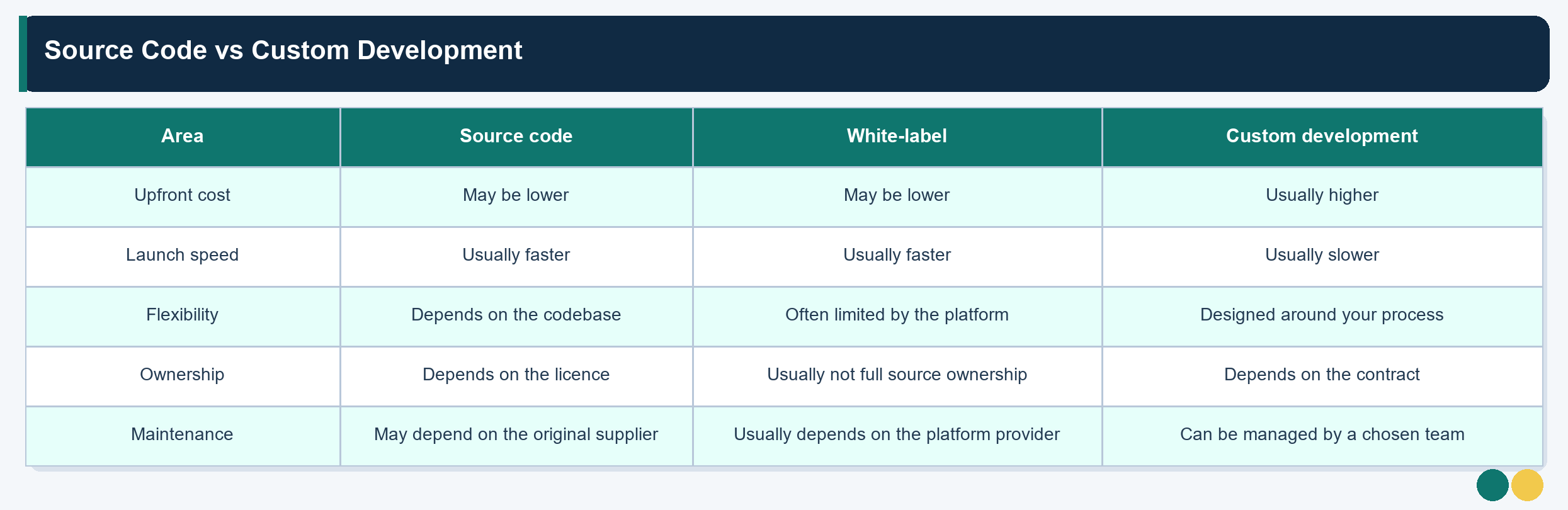
What is the difference between source code, white-label and custom development?
A source code solution uses an existing application foundation. The core modules may already include login, users, orders, notifications, dashboards or basic administration. Your company then customizes the branding, screens and business workflow. It is not necessarily a complete app that can be published immediately.
A white-label system usually allows a business to use an existing platform under its own brand. The supplier may change the logo, colours, app name and selected screens. However, the level of customization depends on the platform and the licence agreement. White-label access does not automatically mean that your company owns the full source code.
Custom development starts from your own business requirements. The team designs the user journey, architecture, backend, database, integrations and administration tools around your process. This offers more flexibility, but it normally requires more planning, development and testing before launch.
Why can source code solutions cost less?
The main reason is reuse. A supplier may already have working modules for common functions such as user registration, membership, orders, dashboards and notifications. The team does not have to design and build every basic component from the beginning.
This can reduce duplicated design and development work. It also allows a business to launch an MVP first, collect feedback and add more features later. For a company with a standard workflow, this may make the first project easier to budget.
The price difference becomes smaller when the project needs heavy customization.
This can happen when you require:
· A special membership, permission or settlement workflow.
· Deep integration with ERP, CRM, inventory or internal databases.
· Complex payment, logistics, mapping, live chat or real-time functions.
· Multiple platforms, languages, user roles and administration layers.
· Data migration or a completely new UI/UX system.
For this reason, “half the price” should be treated as a project-specific comparison, not a standard market rule.
How should you compare the quotations?
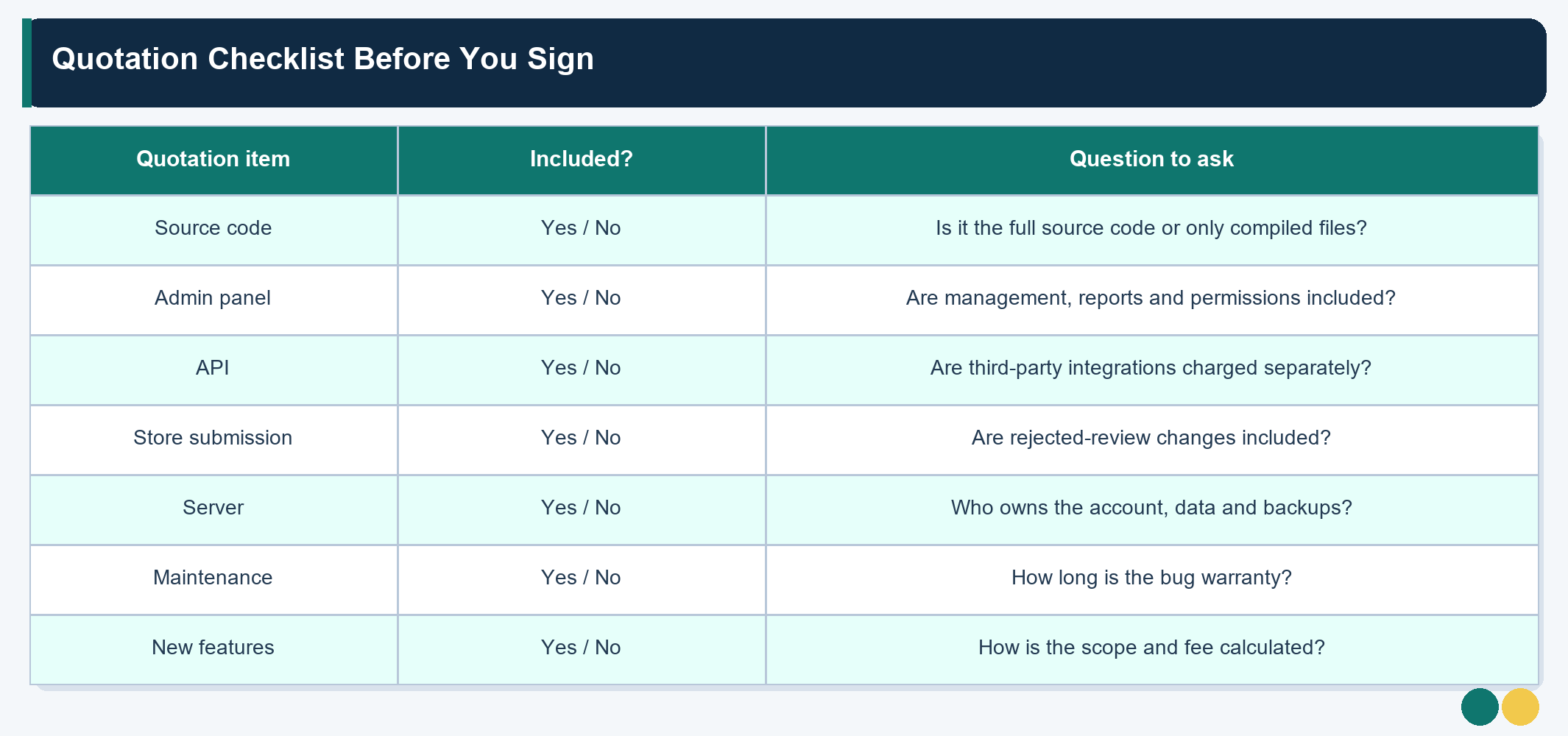
Do not compare only the total price. Ask whether every quotation includes the same features, platforms, backend, integrations, testing, app store submission and handover documents.
What other costs should you expect after buying source code?
· Source code licensing: confirm whether it is a one-time licence, subscription or usage-based licence.
· Branding and UI/UX changes: check whether design work is included.
· Feature customization: separate existing modules from newly developed features.
· API integrations: payment, maps, SMS, logistics, CRM, ERP and e-invoicing may require additional work.
· Servers and domains: confirm who owns the accounts, backups and deployment environment.
· App store accounts: confirm who registers and controls the Apple and Google accounts.
· Maintenance: separate bug fixes, upgrades, server management and new features.
· Data migration: confirm whether legacy data can be imported and who prepares it.
Who should choose source code or white-label?
A source code or white-label option may suit a business that:
· Wants to validate a business model before building a larger platform.
· Has a workflow similar to common e-commerce, booking, delivery or membership apps.
· Can work with part of an existing system structure.
· Needs an MVP rather than a full enterprise platform on day one.
· Wants to reduce duplicated development work at the beginning.
Custom development may be more suitable when:
· The company has a unique workflow that existing systems cannot support.
· The app must connect deeply with ERP, CRM, inventory or internal databases.
· The product has complex permissions, settlement, commissions or multi-role logic.
· The app will become a long-term core business system.
· The company needs stronger control over data, servers and technical architecture.
If the business process is still changing, the target users are not validated, or the company only needs simple forms, bookings or customer records, a complete custom app may be premature. A discovery phase, prototype or MVP can help reduce the first decision.

How can you check source code quality and supplier risk?
A polished demo is not enough. The long-term cost depends on what is actually delivered and whether your company can control the system.
Before signing, ask:
· Is the frontend, backend, database and administration panel included?
· Can the system be deployed on your own server?
· Will you receive API documentation, database notes and deployment files?
· Does the code use third-party components or open-source libraries?
· Are those components licensed for commercial use?
· Can you modify, copy, resell or use the system for related companies?
· Are there limits on the number of apps, countries, industries or customers?
· Can the app and data continue running if the supplier stops supporting it?
· How long is the bug warranty, and how are new features charged?
· Who controls the Apple, Google, cloud, payment and domain accounts?
Malaysia’s Copyright Act 1987 treats computer programs as copyright-protected works. Whether your company receives copyright ownership, an exclusive licence or only a right to use the software depends on the agreement. Ask for the rights in writing instead of relying on a sales explanation.
Your quotation should clearly show:
What should you prepare before requesting a quotation?
The clearer your information, the easier it is to compare suppliers.
Prepare these items before the first quotation call:
1. Define the target users and business goal.
2. List the must-have features for the first release.
3. Separate first-phase, second-phase and later features.
4. Confirm whether you need iOS, Android, web or cross-platform support.
5. Prepare information about your website, database, ERP or CRM.
6. List payment, map, SMS, logistics or e-invoice integrations.
7. Ask for a demo, feature list, delivery list and project schedule.
8. Review source code, account, data, licence and maintenance clauses.
9. Confirm payment milestones, acceptance criteria, bug warranty and change-request fees.
10. Calculate the first-year total cost, not only the development fee.

FAQ
Is a source code solution really half the price of custom development?
Not necessarily. It may reduce the amount of basic development, but licensing, customization, integrations and maintenance can change the final difference.
What do I still need to pay after buying an app source code?
Common costs include branding and feature customization, servers, third-party APIs, app store accounts, maintenance, data migration and later development.
Can I modify the app source code myself?
That depends on whether the full source code is delivered, how the system is structured and what the licence agreement allows.
Which businesses are suitable for source code solutions?
They are often suitable for businesses with a relatively standard workflow that want to validate the market or launch an MVP first.
What is the difference between source code and a white-label system?
White-label usually focuses on using an existing platform under your brand. Source code solutions require a separate check of source delivery, modification rights and licensing.