

5 Restaurant POS Systems Compared: StoreHub, iCHEF or China Source Code?
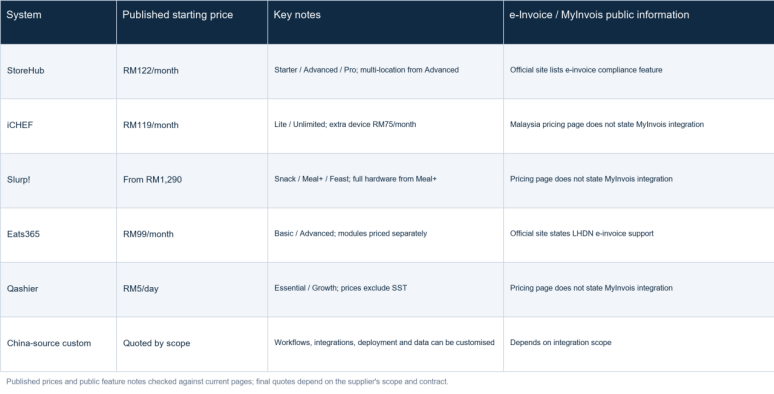
Bottom line: published starting prices range from RM5/day, RM99/month to RM471/month. Single outlets should compare monthly cost; multi-outlet groups should compare 24-month total cost before considering custom code. Published prices are not final project quotes: hardware, modules, payment fees, SST, setup, training and maintenance may be separate.
What are the five restaurant POS options, and who are they for?
A restaurant POS is more than a cash register. It can connect ordering, kitchen operations, inventory, customer data, payments, reporting and e-Invoice workflows. Start with the operating model, then compare price.
1.StoreHub: centralised management for growing outlets
StoreHub moves from basic sales, inventory and reporting to multi-location management, advanced inventory, stock transfers, API access and basic custom development. It is a practical shortlist for businesses planning expansion.
2.iCHEF: an iPad-centred cloud POS
iCHEF is built around cloud POS and iPad operations. Lite targets smaller food businesses; Unlimited adds full inventory, CRM, GrabFood, foodpanda, Xero and a contactless takeaway shop. Its Malaysia pricing page does not state MyInvois integration, so confirm that workflow separately.
3.Slurp: software, hardware and QR ordering in packages
Slurp packages move from basic POS, cloud menu, reporting and inventory to full hardware, QR ordering, integrated payments, multi-outlet monitoring and customer displays.
4.Eats365: modular expansion
Eats365 uses a core POS plus add-on modules. Options include mPOS, scan-to-order, kitchen display, self-ordering, online ordering and multi-location functions. The modular model can change the total cost as the operation grows.
5.Qashier: daily subscription with payment and outlet tools
Qashier publishes Essential and Growth plans. Growth adds ingredient management, product combos, QR ordering, invoices and integrations. The public price excludes SST, and the site also lists POS and hardware bundles.
6.China-source-code POS: a custom development route
China-source-code POS is not one standard product. Code quality, integrations, deployment, maintenance and data ownership vary by supplier. It makes sense only when a standard POS cannot handle a critical workflow.

How much do the five restaurant POS options cost?
Use published pricing for an initial shortlist. Before signing, ask every supplier to quote the same cost categories.
· StoreHub: Starter RM122/month, Advanced RM235/month and Pro RM471/month. The current hardware page shows hardware bundles rather than one complete public price list.
· iCHEF: Lite RM119/month and Unlimited RM229/month; additional device RM75/month. Printer RM595–RM988 and cash drawer RM350.
· Slurp!: Snack RM1,290, Meal+ RM4,290 and Feast RM6,490. The public page shows package prices; contract and renewal terms should be read in the supplier quote.
· Eats365: Basic RM99/month and Advanced RM199/month. mPOS, scan-to-order, KDS and self-ordering modules are priced separately; hardware, installation and payment costs depend on the selected setup.
· Qashier: Essential RM5/day and Growth RM8/day. Public prices exclude SST; the website separately presents POS and hardware bundles.
Why compare 24-month total cost instead of monthly price alone?
The number that matters to an owner is the cost of running the system over time. Use one formula for every supplier:
24-month total cost = software subscription + POS hardware + printer/cash drawer/KDS + QR or online modules + payment MDR + SST + setup and training + maintenance and renewal.
For one outlet, focus on device count, printers, payment fees and staff learning time. For multiple outlets, compare additional outlet licences, stock transfers, permissions, head-office reporting and data synchronisation. For custom code, separate development, hosting and annual maintenance.
How should you choose? Match the POS to the operating model
Single café or small restaurant
Prioritise checkout speed, menu editing, basic inventory, reporting and staff onboarding. If key functions are add-ons, the final bill may look very different from the entry price.
Busy dining room with clear peak periods
Test table management, split and merge bills, order changes, kitchen printing, KDS, customer displays and whether the system can continue taking orders during a connection problem.
Takeaway, QR ordering or delivery-led operation
Confirm whether online orders enter the POS directly, whether payment status is returned, whether inventory stays synchronised and whether GrabFood or foodpanda needs extra modules.
Multi-outlet group or expansion plan
Compare head-office controls, real-time sales, stock transfers, permissions, unified menus, reporting and APIs. The first outlet's price should not be the only comparison point.
For Malaysian Chinese business owners, bring a Chinese menu to the live demo. Test multilingual staff operations, DuitNow QR, Touch ’n Go, cards, customer records, refunds and e-Invoice.
When does a China-source-code POS make sense?
Custom development belongs on the shortlist only when an off-the-shelf POS cannot support a critical workflow, such as complex outlet settlement, unique membership rules, specialised supply-chain processes, internal approvals, custom reporting or ERP integration.
There is no single market price for China-source-code POS. Obtain a written quote based on the requirements document, then put the scope into the contract.
Before signing, define the scope, delivery date, acceptance criteria, source-code and data ownership, third-party integration fees, server responsibility, warranty period, maintenance fee, backup method, security responsibility and the data-migration plan if the supplier exits.
How do you get started? From requirements to go-live
1. Confirm the number of outlets, checkout stations, kitchen stations, staff and order flows. Prepare menu, inventory, customer, tax, company-registration and payment information.
2. Request an itemised quotation covering hardware, software, modules, SST, payment, setup, training and renewals.
3. Test e-Invoice, DuitNow QR, refunds, voids, split bills, merged bills and connection-loss procedures.
4. Import the menu and inventory. Configure permissions, discounts, taxes, printer routing and reports.
5. Train staff, run a soft launch, then switch fully after the core workflows reconcile.
6. After go-live, reconcile sales, inventory, payment settlement and e-Invoice reports, then schedule fixes.
e-Invoice onboarding: confirm your eligibility first
LHDN's timeline updated on 30 August 2026 states: taxpayers above RM100 million began on 1 August 2024; above RM25 million up to RM100 million on 1 January 2025; above RM5 million up to RM25 million on 1 July 2025; up to RM5 million on 1 January 2026; and taxpayers below RM3 million are exempt. Actual eligibility still depends on the taxpayer's circumstances and related-company rules.
The MyInvois Portal is provided at no charge and supports submitting, viewing, rejecting, cancelling and printing e-Invoices. Businesses can also connect a POS or ERP through the MyInvois API. Under LHDN Specific Guideline Version 4.7, eligible taxpayers with annual turnover or revenue up to RM5 million and implementation dates of 1 January or 1 July 2026 have an interim relaxation period until 31 December 2027, subject to the stated conditions.

FAQ
How much does StoreHub cost per month?
StoreHub publishes starting prices of RM122, RM235 and RM471 per month for Starter, Advanced and Pro. Hardware, payment, SST and add-on modules may be separate.
How much does iCHEF POS cost in Malaysia?
iCHEF Malaysia publishes RM119/month for Lite and RM229/month for Unlimited, with additional devices at RM75/month. Printers and cash drawers are separate.
Do Malaysian restaurants need to use e-Invoice?
The answer depends on annual turnover, the latest LHDN timeline and related-company rules. Restaurant type alone does not determine the obligation.
How much does a China-source-code POS cost?
There is no single market price. Obtain a written quote based on workflows, integrations, hardware, migration, deployment and maintenance scope.
Which POS is suitable for a small restaurant?
Compare entry price, hardware cost, training time, basic inventory, payment methods, e-Invoice readiness and future expansion needs together.