

A Lalamove-style logistics app in Malaysia can range from a public-market reference of RM15,000 for a basic MVP to RM250,000+ for a complex platform. If you need a customer app, driver app, automated dispatch and real-time tracking, do not budget it like a simple brochure app.
When business owners ask about logistics app cost, they are usually asking four questions: Can customers place orders? Can the system dispatch drivers? Can customers see the driver's location? Can payments and operations run smoothly? This guide breaks the budget down by function.
What does a logistics app actually need to do?
The Lalamove Malaysia website shows multi-stop delivery, scheduled delivery, vehicle selection, payment, coupons and GPS real-time tracking. It states that users can set up to 20 destinations and schedule a delivery up to 30 days in advance. These are common requirements for a similar platform.
From a system perspective, plan for at least three sides:
· Customer app: registration, booking, addresses, vehicle type, quotation, payment, order status, tracking and delivery records.
· Driver app: accept or reject jobs, update delivery status, navigate, upload proof of delivery and view earnings.
· Admin panel: orders, drivers, pricing, coupons, customer service, disputes and reports.
A single booking page with manual driver assignment can cost much less. It is not the same project as a full Lalamove-style platform.
How much does it cost to build a Lalamove-style logistics app?
Public Malaysian supplier pages commonly publish the following reference ranges. They are market estimates, not a standard quotation. Final pricing depends on scope, platforms and third-party services.
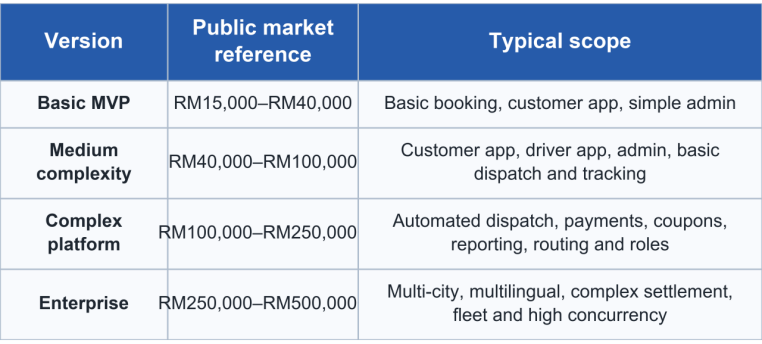
For most businesses planning a Lalamove-style service, the useful comparison is between medium complexity and complex platform scope, not the lowest basic-MVP number.
Which features increase the quotation?
First, the number of roles. Customers, drivers, dispatchers, support staff, finance users and administrators each add permissions, screens and testing.
Second, dispatch logic. Manual assignment is relatively simple. Assignment by distance, vehicle type, driver status, service zone, priority and traffic conditions requires more backend logic.
Third, route tracking. Real-time location requires driver-side location uploads, map refreshes, backend status storage and sometimes route recalculation.
Fourth, payment and settlement. If the platform collects customer payments and later splits commission, refunds and driver earnings, the finance logic is more than a payment button.
Fifth, the number of platforms. Android only, iOS and Android, and a web admin panel all affect development and testing effort.
Do maps, payments and SMS cost extra?
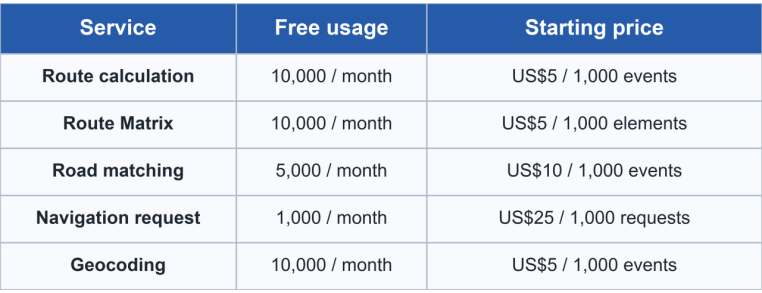
Map APIs are generally usage-based. In Google's current global price list, Compute Routes Essentials includes the first 10,000 events per month at no charge, then starts at US$5 per 1,000 events. Compute Route Matrix Essentials also includes the first 10,000 elements, then starts at US$5 per 1,000 elements.
For payments, Stripe Malaysia lists standard pricing at 3% + RM1.00 per successful domestic card charge or bank transaction, with possible additional charges for international cards and currency conversion. For SMS, Twilio Malaysia lists US$0.3389 per message segment from international numbers, with possible carrier fees.
When requesting a quotation, clarify who opens and pays for each third-party account, whether API configuration is included, and who monitors monthly usage after launch.
How should you choose a development approach?
If budget is limited and you want to validate the market first, build in phases. Phase one can cover booking, driver acceptance, simple dispatch and basic tracking. Phase two can add payments, coupons, business accounts and driver settlement. Phase three can add route optimisation, multi-city operations and analytics.
You can also compare three approaches:
· Custom development: higher upfront investment, but the workflow, data and feature set can be designed around your business.
· White-label system: faster launch, but confirm source code, data ownership, branding limits and future expansion rights.
· SaaS subscription: lower initial cost, but recurring monthly fees and vendor limits apply.
Do not compare only the total price. Put every feature, deliverable, source-code right, warranty, hosting, API account and maintenance scope into the Scope of Work.
How do you start from quotation to launch?
1. Map the order flow: who books, who accepts, who dispatches, who collects payment and who handles exceptions.
2. Define the MVP: keep launch-critical features and move coupons, wallets and advanced routing to later phases.
3. Confirm the technical plan: iOS, Android, web admin, and native or cross-platform development.
4. Request module-based pricing: customer app, driver app, admin panel, maps, payments, SMS, QA and deployment should be listed separately.
5. Create prototypes and acceptance criteria: every critical flow should have a testable acceptance condition.
6. Test real scenarios before launch: vehicle types, multiple destinations, driver rejection, cancellation, refund, offline conditions and network interruptions.
7. Monitor three post-launch cost drivers: map calls, SMS volume and hosting usage, instead of looking only at the one-time development fee.
What should a business owner look at before deciding?
If you only need booking and manual driver assignment, a basic MVP may be enough. If you want a Lalamove-style experience, budget for the customer app, driver app, admin panel, automated dispatch, route tracking, payments and compliance.
The practical next step is a module-based quotation. Instead of asking only “How much does an app cost?”, ask “Does this price complete my actual order flow?”
Prepare your service zones, vehicle types, daily orders, driver count, payment methods and launch-critical features before requesting an estimate.
FAQ
How much does it cost to build a Lalamove-style logistics app?
Public market references range from RM15,000–RM40,000 for a basic MVP to RM100,000–RM250,000+ for a complex platform. A full enterprise project may be higher. Assess the scope rather than relying on one number.
How long does logistics app development take?
Public supplier pages commonly cite 4–8 weeks for a basic MVP, 2–4 months for medium complexity and 4–8 months for complex projects. Confirm the actual timing in the project plan.
Does real-time map tracking cost extra?
Usually yes. Google Maps Platform bills by API usage, and route, geocoding, route-matrix and navigation services use different billing units.
Can we launch Android first?
Yes. Starting with one platform can validate the workflow, but confirm whether customers use iPhone and whether drivers use Android before finalising the plan.
What is most commonly missing from quotations?
Driver-side features, automated dispatch, API usage, OTP, refunds, driver settlement, hosting, source code, maintenance and post-launch security updates are common omissions.