

What types of business management software are available in Malaysia?
Business owners usually face three choices: cloud SaaS, on-premise software, or a source-code solution.
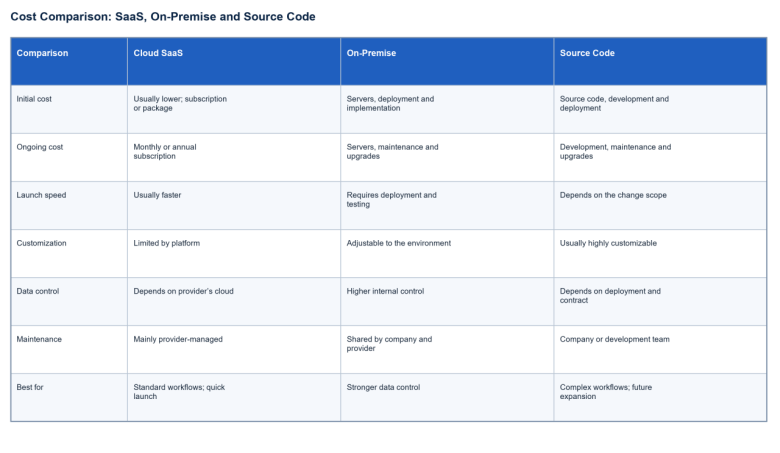
Software as a Service (SaaS) is hosted and maintained by the provider. The business subscribes monthly or annually and accesses the system through an account.
On-premise software is installed on the company’s own server or a designated private environment. The company has more control over the environment, but it also takes on responsibility for servers, backups, security and upgrades.
A source-code solution is based on an existing system whose source code can be obtained or deeply modified. It can suit businesses with unusual workflows or a long-term need for independent maintenance.
Compliance should be checked early. An electronic invoice (e-Invoice) is not simply a PDF sent to a customer. Transaction data is submitted digitally and handled through LHDN’s MyInvois. Support for the MyInvois Portal, API integration and data retention should be part of the selection criteria.
LHDN: e-Invoice and its benefits
How much does business management software in Malaysia cost?
There is no single standard price. The total cost usually includes:
· Software subscription or licence fees
· User and outlet fees
· Initial setup and data migration
· Custom development and third-party integrations
· Training, maintenance and technical support
· e-Invoice, reporting or API-related fees
The table below compares cost structure. Ask every supplier for an itemized quotation instead of comparing only one package price.
If the budget is tight, ask three numbers first:
1. What is the total first-year cost?
2. What fixed annual costs begin in year two?
3. What changes if the company adds users, outlets, reports or integrations?
How should different Malaysian businesses choose?
1. Small or newly established teams
For a small team with standard workflows, start with SaaS. Look for quick setup, easy adoption, basic sales and inventory functions, and clear recurring fees. If the business only needs invoicing, inventory, customer management and basic e-Invoice handling, it may not need the server and development burden of a complex deployment from day one.
2. Mid-sized and multi-department teams
Check permissions and workflows carefully. Sales, finance, purchasing and management should see different data while the underlying records remain connected. Compare mature SaaS products with on-premise options based on multi-department, multi-role and approval-flow support.
3. Multi-outlet or fast-growing businesses
Include future outlets in the cost calculation. Confirm whether headquarters can see consolidated data, whether outlets can operate independently, whether stock can move between outlets, and how fees change as new outlets are added.
4. Businesses that need stronger data control
Businesses handling sensitive financial information, complex permissions or internal integrations can evaluate on-premise deployment. It still requires server management, backups, access control, security updates and incident handling.
5. Businesses with unusual workflows
If quoting, production, commissions, approvals or inventory workflows are unusual, compare source-code solutions with custom development. Confirm code ownership, modification rights, technical documentation, database structure and long-term maintenance responsibility.
What should you check before choosing software?
Do not stop at the feature list on a product page. Ask whether those features actually fit the company’s daily workflow.
· Can sales, purchasing, inventory and finance share connected records?
· Does it support multiple users, outlets and permission levels?
· Can the business export its complete data?
· Can it connect to the existing POS, accounting or e-commerce system?
· Does it support e-Invoice workflows?
· Can it submit data through the MyInvois Portal or API?
· Are backup, recovery and activity logs available?
· Are training, implementation support and after-sales service included?
If a supplier says only “e-Invoice supported”, ask for more detail:
1. Does it use the MyInvois Portal or an API integration?
2. Who configures company data and tax fields?
3. Will the system show the reason for a failed submission?
4. Can the invoice status be tracked?
5. Can data be exported and retained long term?
The official MyInvois technical materials include API documentation. Ask the supplier to demonstrate the real workflow before purchase.
Official MyInvois API documentation
How should a business get started after choosing a solution?
1. Map the workflow: Write down the three most frustrating operational problems. The software should solve those problems, not simply add more features.
2. Set the budget and scope: List users, outlets, required modules, launch date and the preferred maintenance model.
3. Shortlist providers: Compare at least two or three providers and request features, implementation timing, itemized pricing, service scope and exit terms.
4. Run a trial or test: Let sales, finance, inventory and management users test permissions, reports and daily operations.
5. Confirm the contract: Document feature scope, user and outlet calculations, customization acceptance, data ownership, export method, response time and upgrade terms.
6. Launch in stages: Start with sales, inventory or e-Invoice, then connect finance, purchasing and reporting step by step.

FAQ
How much does business management software in Malaysia cost?
There is no single price. SaaS is commonly charged by subscription, user or outlet, while on-premise and source-code solutions add server, deployment, development and maintenance costs. Ask for the full first-year and recurring annual cost.
Is SaaS or on-premise software better?
It depends on the business. SaaS can suit companies that want faster deployment and less technical maintenance; on-premise can suit companies that place more weight on internal data control.
What is the difference between source-code software and custom development?
Source-code software usually modifies an existing system. Custom development may redesign the requirements, architecture and features more extensively. In both cases, clarify code ownership, intellectual property, documentation and maintenance.
Is SaaS business management software suitable for a small business?
It can be a practical starting point when workflows are standard. Check recurring fees, user limits, data export, support and e-Invoice capability first.
How does e-Invoice software connect to MyInvois?
Confirm whether the system uses the MyInvois Portal or an API. Then check company data, customer data, tax fields, submission status, error handling and data retention through a live demonstration.