

What Features Does a Food Delivery Platform Like Foodpanda Need?
A complete food delivery system has at least four parts: the customer app, merchant app, rider app and admin portal. There is no single fixed development price; the budget must be quoted according to the feature scope, number of platforms and third-party integrations.
What Is a Food Delivery System Like Foodpanda?
· The basic model of a multi-merchant food delivery platform
· Customer app, merchant app, rider app and admin portal
· The difference between a marketplace platform and a single-restaurant ordering system
What Core Features Does a Food Delivery System Need?
· Customer app: registration, addresses, restaurant search, menus, cart, coupons, payment, order tracking, ratings and after-sales support.
· Merchant app: menus, prices, images, inventory, operating hours, order acceptance, preparation time, promotions and sales reports.
· Rider app: registration and verification, online status, job acceptance, navigation, pickup, proof of delivery, earnings and settlement.
· Admin portal: users, merchants, riders, orders, zones, commissions, coupons, refunds, settlements, reports and permissions.
· Order states: pending payment, paid, merchant accepted, rider assigned, preparing, picked up, delivering, completed, cancelled and refunded.
· Third-party integrations: payments, maps, address search, routing, SMS OTP, push notifications, cloud services and analytics.
How Much Does It Cost to Develop a Food Delivery System?
· One-time development costs: product planning, UI/UX, frontend, backend, admin portal and testing.
· Third-party service costs: payments, maps, SMS, push notifications, servers, databases and storage.
· App-store costs: Apple Developer Program and Google Play Console.
· Ongoing costs: servers, maintenance, bug fixes, upgrades, customer support and marketing.
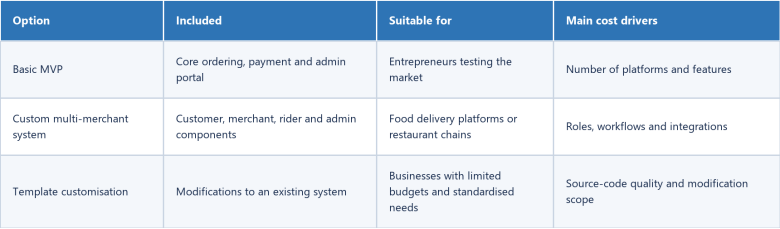
· The quote is shaped by the number of platforms, user roles, business rules, integrations and required scalability.
Should You Choose Custom Development or a Template?
· Custom development: suitable for unique order rules, commissions, delivery zones, settlements or future expansion.
· Template development: suitable for businesses with standard workflows that want to validate the market first.
· Compare initial budget, launch speed, source-code control, scalability, data security and long-term maintenance.
· Define the MVP first, then decide which features should be released in phase one.
What Should Malaysian Businesses Prepare Before Launch?
· Payments: DuitNow QR, FPX, bank cards and e-wallets.
· Maps: address search, distance calculation, routing and real-time rider location.
· Tax: determine whether Malaysia e-Invoice requirements apply based on revenue and business structure.
· Privacy: prepare privacy notices, data access controls, retention and deletion processes under PDPA.
· App stores: prepare Apple Developer and Google Play organization accounts, company details and review materials.
· For physical food orders, handle payments according to Apple and Google Play rules for physical goods and services.
Where Should You Start When Developing a Food Delivery System?
1. Define the business model, target areas, restaurant types and delivery model.
2. Decide the must-have MVP features and the features to postpone.
3. Map the complete order flow for customers, merchants, riders and administrators.
4. Choose payment, maps, SMS and cloud-service providers.
5. Obtain the developer's feature list, quotation, milestones and maintenance terms.
6. Complete UI/UX, development, integrations, testing, app-store review and launch.
7. After launch, optimise using order volume, conversion, cancellation and delivery-time data.
FAQ
What is the difference between a single-restaurant ordering system and a multi-merchant food delivery platform?
A single-restaurant ordering system serves one brand and focuses on its menu, kitchen and own orders. A multi-merchant food delivery platform also needs merchant onboarding, commissions, settlements, rider dispatch, delivery zones, permissions and dispute handling.
Why does a food delivery platform need separate customer, merchant and rider components?
The three user groups have different goals and permissions: customers place orders, merchants accept and prepare them, and riders collect and deliver them. Separate components make the workflow clearer and reduce permission and data-security problems.
Are food delivery payments subject to App Store commission in Malaysia?
Food delivery is a physical-goods or physical-services transaction. Apple and Google Play do not require this type of payment to use digital in-app purchasing systems, so digital-content app-store commission rules should not be applied automatically; digital memberships or app features must be assessed separately under the relevant policies.
What should be confirmed in a food delivery system quotation?
The quotation should identify the customer, merchant, rider and admin features, UI/UX scope, iOS and Android coverage, payment and maps integrations, testing, store submission, source-code ownership, warranty, maintenance, hosting, third-party services and the pricing method for later changes.
What ongoing costs does a food delivery platform have after launch?
Ongoing costs may include servers, databases, image storage, map usage, SMS OTP, payment transaction fees, app-store accounts, maintenance and version upgrades. The actual amount depends on orders, users, API usage and the chosen providers, so it cannot be judged from the one-time development fee alone.