
What is the relationship between e-Invoice and POS?
An electronic invoice (e-Invoice) is not an ordinary receipt saved as a PDF. It is a digital transaction record submitted to Malaysia's tax authority, LHDN, and it contains supplier, buyer, item, quantity, price, tax and total-value information.
e-Invoice can be used for B2B, B2C and B2G transactions. A PDF, JPEG or DOC file can be used as a visual presentation, but it does not replace a validated e-Invoice on its own.
The POS collects and organises transaction data at checkout, then sends it through MyInvois Portal or API. In simple terms, the POS is the front-end transaction tool, while MyInvois is the submission and validation platform.
Businesses generally have two routes. MyInvois Portal suits businesses without an ERP, businesses with lower transaction volume, or teams that want to start manually. API integration suits multi-outlet businesses, higher transaction volume and automated invoice tracking.
LHDN also provides MyInvois e-POS free of charge for micro, small and medium enterprises. Sellers can generate e-Invoices during transactions, and buyers can request an e-Invoice after a transaction is completed.
How much does POS e-Invoice integration cost?
There is no single market price for POS or API integration. The actual cost usually combines software subscription, hardware, users, outlets, data migration, training, custom development and maintenance.
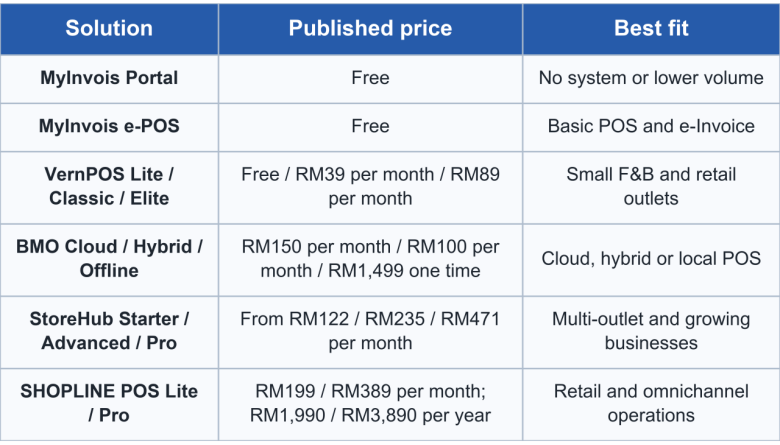
Before buying, ask for these three numbers:
1. What is the complete first-year cost?
2. Which fixed costs start from the second year?
3. What changes when we add users, outlets, reports or API connections?
How should different businesses choose?
A small business with standard sales, inventory and invoicing needs can start with a free plan or a low-cost cloud POS. The practical priorities are easy adoption, clear fees and short staff training.
F&B businesses should check table management, kitchen workflows, payments, discounts, refunds and inventory. A vendor saying “e-Invoice supported” is not enough. Ask whether the system submits directly to MyInvois and whether it shows the reason when a submission fails.
Multi-outlet businesses should look closely at cloud systems. Head office needs consolidated sales, outlets need independent operation, and stock may need to move between locations. Ask how the fee changes when another outlet is added.
Businesses that already use an ERP or accounting system can consider API integration. This avoids repeated data entry, but first confirm that the existing system can produce the fields required by MyInvois.
If the business has unusual approvals, production, commission or inventory workflows, consider a custom API or on-premise deployment. Put code ownership, modification rights, database structure and long-term maintenance responsibilities into the contract.
Which MyInvois functions should you confirm before choosing a POS?
1. Does it really support MyInvois?
Ask the supplier to demonstrate the full flow: create an order, enter buyer details, validate the TIN, submit to MyInvois, receive the validation result, generate a QR code and save the invoice record.
2. Does it collect the right data?
· Supplier name, TIN, BRN, SST Number and TTX Number where applicable.
· Buyer name, TIN, business registration number, identity-card number or passport number.
· Item classification, item description, quantity, unit price, discounts, tax type, tax rate, tax amount and payment mode.
· Invoice date and time, plus Credit Note, Debit Note and Refund Note support.
3. Can it handle errors?
If the TIN, tax amount or customer data is wrong, the system should show a useful reason instead of only saying “submission failed”.
For a validated e-Invoice, the buyer can submit a rejection request within 72 hours of validation, and the seller can cancel within the same window. After that, the usual adjustment route is a Credit Note, Debit Note or Refund Note.
4. Does the API meet the technical requirements?
The MyInvois API supports JSON and XML based on UBL 2.1. The official SDK also sets a maximum of 100 e-Invoices per batch, 5 MB per submission and 300 KB per e-Invoice. After submission, the system should check the status instead of repeatedly resubmitting the same batch.
The system should also retain the submission UID, UUID, validation link and error information. Buyer TINs should preferably be validated and cached when the customer record is created.
What are the steps to connect a POS to MyInvois?
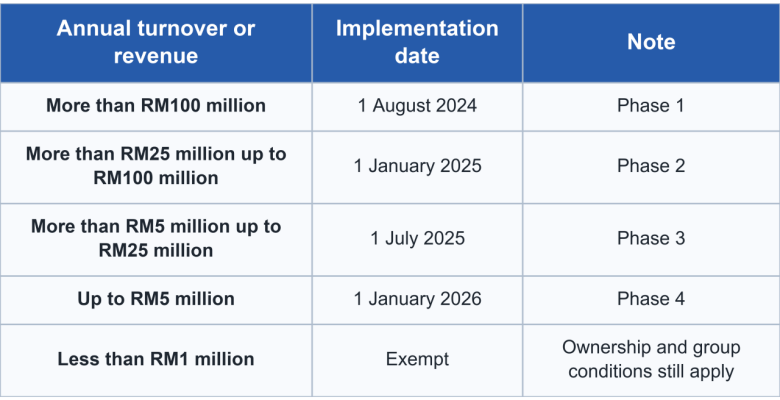
1. Confirm the business implementation date and whether the business qualifies for an exemption. Businesses below RM1 million in annual turnover should also check shareholders, holding companies, related companies and joint ventures.
2. Prepare the business TIN, BRN, SST Number, product classifications, tax rates, customer data and outlet data.
3. Choose MyInvois Portal, MyInvois e-POS, a ready-made integrated POS or API integration.
4. Test customer data, TIN validation, tax fields, QR codes, failed submissions and cancellation in the Sandbox environment.
5. After launch, monitor submission UID, UUID, validation status, error reasons and accounting reconciliation.
6. Set an internal process for returns, corrections, cancellations, Credit Notes, Debit Notes and Refund Notes.
LHDN's current implementation timeline is phased according to annual turnover or revenue. The exemption for businesses below RM1 million also has ownership and group-structure conditions, so sales alone do not determine the answer.
The standard MyInvois API flow is login, submit the document, receive a submission UID, check the submission status and process a valid or invalid result. The system should not resubmit before checking the initial response.
FAQ
Can a POS system connect directly to MyInvois?
Yes. A business can use a POS, ERP or technology provider that supports the MyInvois API. Confirm whether API integration is included in the selected plan.
What is the difference between MyInvois Portal and API?
The Portal is free and suits manual submission. API integration suits automation, multiple outlets and higher transaction volume, but it requires development, testing and maintenance.
Is MyInvois e-POS free?
LHDN states that MyInvois e-POS is available free of charge to micro, small and medium enterprises. Hardware, training and internal operating costs still need to be considered.
How much does POS e-Invoice integration cost?
Public plans range from free options to monthly plans costing several hundred ringgit. Hardware, API, migration and maintenance may be charged separately.
Can an incorrect e-Invoice be cancelled?
Usually, a validated e-Invoice can be cancelled within 72 hours. After that, use a Credit Note, Debit Note or Refund Note where appropriate.