

Under the current e-Invoice Malaysia rules, businesses with annual revenue or sales below RM3 million are generally exempt. Businesses from RM3m to RM5m are generally in Phase 4, with an implementation date of 1 January 2026.
However, “below RM3m” should not be applied without checking the business structure, related companies and the revenue basis used by LHDN.
What is the RM3 million threshold in e-Invoice Malaysia?
An e-Invoice is a digital transaction document submitted by the seller to LHDN for validation and storage. It covers B2B, B2C and B2G transactions. It is being introduced to replace paper or ordinary electronic invoices, and it also covers adjustment documents such as credit notes, debit notes and refund notes.
Under the LHDN e-Invoice Guideline v4.8, taxpayers with annual income or sales below RM3 million are generally exempt. Check carefully if:
· the business has a non-individual shareholder;
· the business is a subsidiary of a holding company;
· the business has a specified relationship with a related company or joint venture, and the relevant business has annual income or sales of at least RM3 million.
The revenue basis is generally the audited Statement of Comprehensive Income for YA2022. For businesses that do not require an audit, the YA2022 tax return is used as the reference. If the accounting period changes, LHDN requires the figure to be adjusted to a 12-month basis. Once the implementation phase is determined, later revenue changes generally do not change the assigned responsibility.
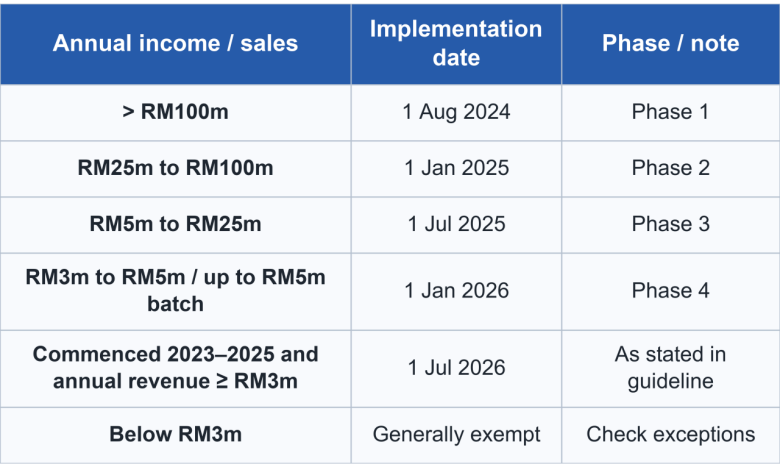
For businesses that commenced operations between 2023 and 2025 and have annual revenue of at least RM3m, the date stated in the LHDN guideline is 1 July 2026. For businesses commencing from 2026 onward, the date is 1 July 2026 or the business commencement date, whichever is later. If the first-year revenue is below RM3m, the guideline sets out a later rule beginning on 1 January of the second year after the year in which total annual revenue reaches RM3m.
A five-minute check: does my business need e-Invoice?
Use this sequence for a quick internal check. It is not tax advice, but it helps you decide whether to confirm the position with your accountant or a system provider.
1. Start with YA2022 annual income or sales, rather than one month’s turnover.
2. Check whether the business has a non-individual shareholder, is a subsidiary, or has a related-company or joint-venture arrangement.
3. Compare the business with LHDN’s phase dates.
4. Map the transaction types: B2B, B2C and B2G, plus self-billing, refunds, discounts and cross-border transactions where relevant.
5. List the existing tools: accounting software, ERP, POS, inventory and payment systems, and identify what needs to connect.
If the business issues only a small number of B2B invoices, the MyInvois Portal may be sufficient. If it processes high-volume retail sales, inventory movements or multiple outlets, manual entry can create repeated work.
How much does e-Invoice implementation cost?
Separate two costs: the LHDN submission channel and the business software used for POS, accounting or ERP. MyInvois Portal is the official channel. The official MyInvois e-POS page states that the e-POS is available free for MSMEs.
If the business needs POS, inventory, outlet permissions, reporting or automated integration, it may incur software subscriptions, hardware, setup, migration and training costs. The examples below are published starting prices, not market averages or final quotes.
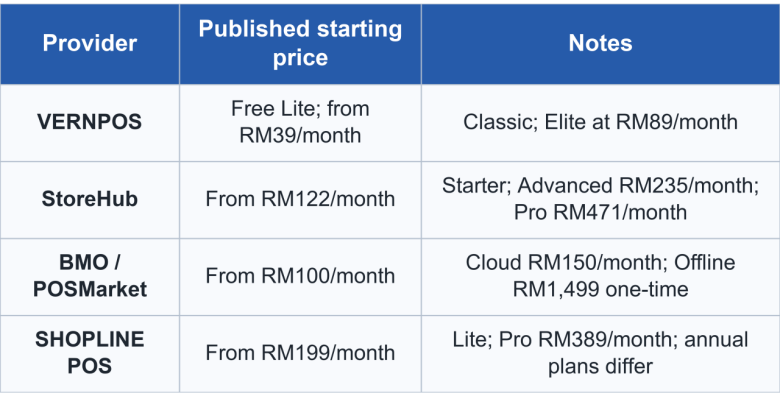
Ask whether SST is included, whether pricing is per user or outlet, and whether scanners, printers, cash drawers and tablets are extra. Also confirm data migration, on-site installation, training, support and API integration. These items can have a larger effect on total cost than the monthly subscription alone.
So do not ask only “how much per month?” Ask for the total first-year cost, the renewal cost and the owner of support when something fails.
How should I choose between MyInvois Portal, API and POS?
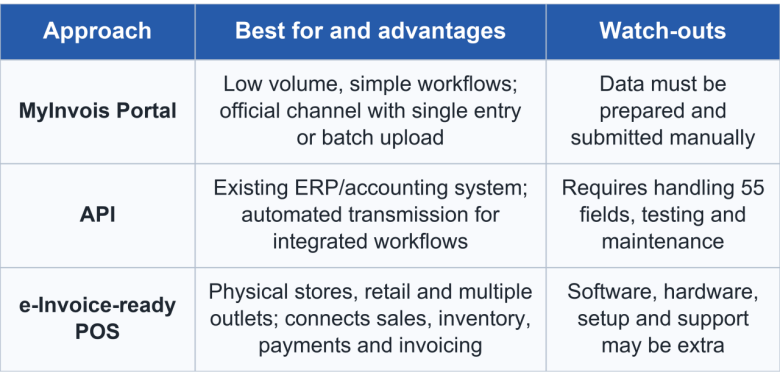
LHDN provides two main submission mechanisms: MyInvois Portal and API. The API allows an ERP, accounting system or other business software to connect directly to MyInvois. POS is the front-end business tool that can combine sales, inventory and payment workflows.
How should a business get started?
Use the sequence below. Clarify the workflow before buying a more complex system.
1. Confirm applicability: check the revenue basis, business structure and LHDN phase.
2. Build a data sheet: organise the company name, TIN, BRN, address, SST details, MSIC activity code, customer details and supplier details.
3. Choose the submission route: Portal, API, or a POS/accounting system that connects to e-Invoice.
4. Register and test: access MyInvois through MyTax, or follow the provider’s API test process.
5. Run a real workflow: test invoice creation, LHDN validation, customer notification, the QR/visual version, cancellation and refunds.
6. Assign daily ownership: define who maintains data, retries failed submissions, reconciles monthly records, stores documents and handles exceptions.
The practical flow is usually: seller submits → LHDN validates → a unique identifier, date, time and validation link are generated → seller and buyer are notified → the e-Invoice or visual representation is shared. If an error is found, rejection or cancellation is generally allowed within 72 hours after validation. After 72 hours, handle the correction with a new invoice, credit note, debit note or refund note as appropriate.
Phase 4 businesses should also note the interim relief in LHDN Specific Guideline v4.8. The current document states that it runs until 31 December 2027 and, subject to conditions, permits consolidated e-Invoices and consolidated self-billed e-Invoices. A single transaction above RM10,000 is not eligible for a consolidated e-Invoice. Check the latest guideline for the precise conditions and limits.
Finally, do not interpret submission to LHDN as meaning that the business no longer needs records. LHDN stores validated e-Invoices, but the business must still keep sufficient accounting and transaction records.

FAQ
Does a company below RM3 million need e-Invoice?
It is generally exempt, but check the business structure, related companies and exceptions in the LHDN guideline.
When does a company between RM3m and RM5m start e-Invoice?
Under the current LHDN phase timeline, most fall under 1 January 2026. Confirm using the business’s revenue basis and the latest guideline.
Is the MyInvois Portal free?
MyInvois is LHDN’s official submission channel. Additional POS, accounting software, hardware or integration services may still incur vendor costs. The official MyInvois e-POS page states that it is free for MSMEs.
Can an e-Invoice be cancelled?
Rejection or cancellation is generally available within 72 hours after validation. After that, use a new invoice or an adjustment document as appropriate.
Should a small business use Portal, API or POS?
Use the Portal for low-volume transactions, assess API for an existing ERP or accounting system, and evaluate POS for physical stores or multi-outlet operations.