

Malaysia e-Invoice Penalty: 5-Minute Compliance Checklist for Businesses
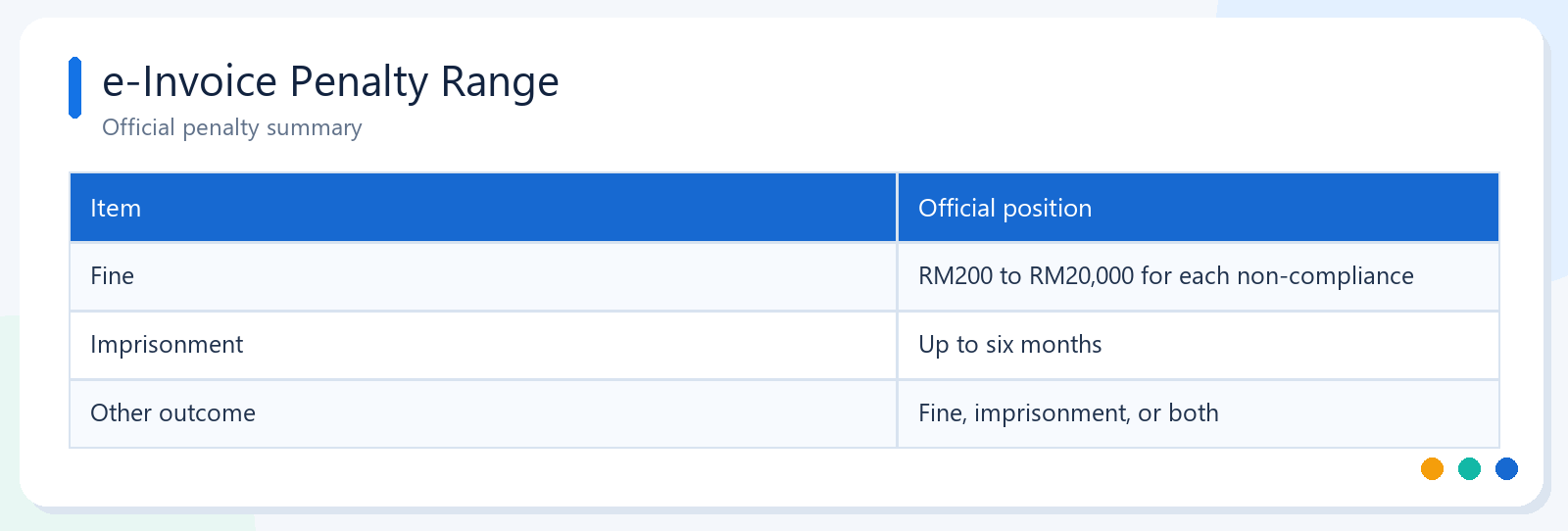
For Malaysian business owners, partners and finance managers, the first step is to confirm the company’s implementation date and transition arrangement. Where the relevant requirements are not followed, failure to issue an e-Invoice may result in a fine of RM200 to RM20,000, imprisonment of up to six months, or both.
Which businesses need to implement e-Invoice in 2026?
The Inland Revenue Board of Malaysia (LHDN) is implementing e-Invoice in phases.
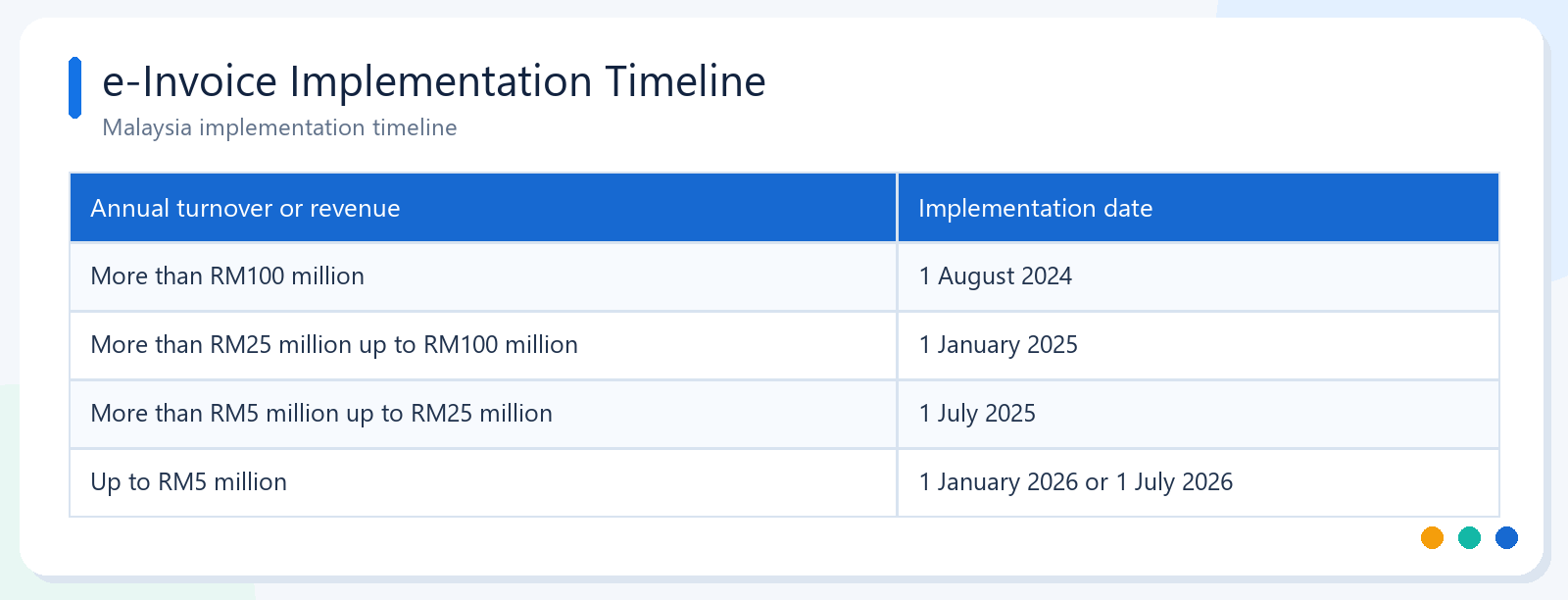
For taxpayers with annual turnover or revenue of up to RM5 million, the interim relaxation period currently runs until 31 December 2027.
Businesses below RM1 million may qualify for an exemption, but the exemption criteria must be checked separately.
What is the penalty for failing to issue e-Invoice?
LHDN’s Frequently Asked Questions (FAQ) states that failure to issue an e-Invoice is an offence under Section 120(1)(d) of the Income Tax Act 1967.
The transition arrangement is not a blanket exemption. During the interim relaxation period, IRBM will not undertake prosecution action under Section 120 for e-Invoice non-compliance where taxpayers follow the permitted consolidated e-Invoice or consolidated self-billed e-Invoice arrangements.
Businesses are still required to:
Compile sales records on a monthly basis.
Retain receipts and invoice‑related documents.
Submit consolidated e‑Invoices in accordance with regulations.
Ensure complete data within Point‑of‑Sale (POS) or accounting systems.
Regularly monitor updates from LHDN and MyInvois.
How can the transition grace period be utilised?
During the transition period, eligible businesses may adopt more flexible invoicing arrangements. For instance, instead of issuing an individual e‑Invoice for every single transaction, businesses may compile qualified transactions into a consolidated e‑Invoice.
Subject to relevant conditions, LHDN also permits eligible businesses to use consolidated e‑Invoices and consolidated self‑billed e‑Invoices. Where applicable, businesses may continue to handle buyers’ requests for individual e‑Invoices via consolidated processing.
Nevertheless, the general consolidation rules may not apply to certain industries or transaction types. Businesses should not rely solely on turnover; they must also verify their types of transactions.
What should a business prepare first?
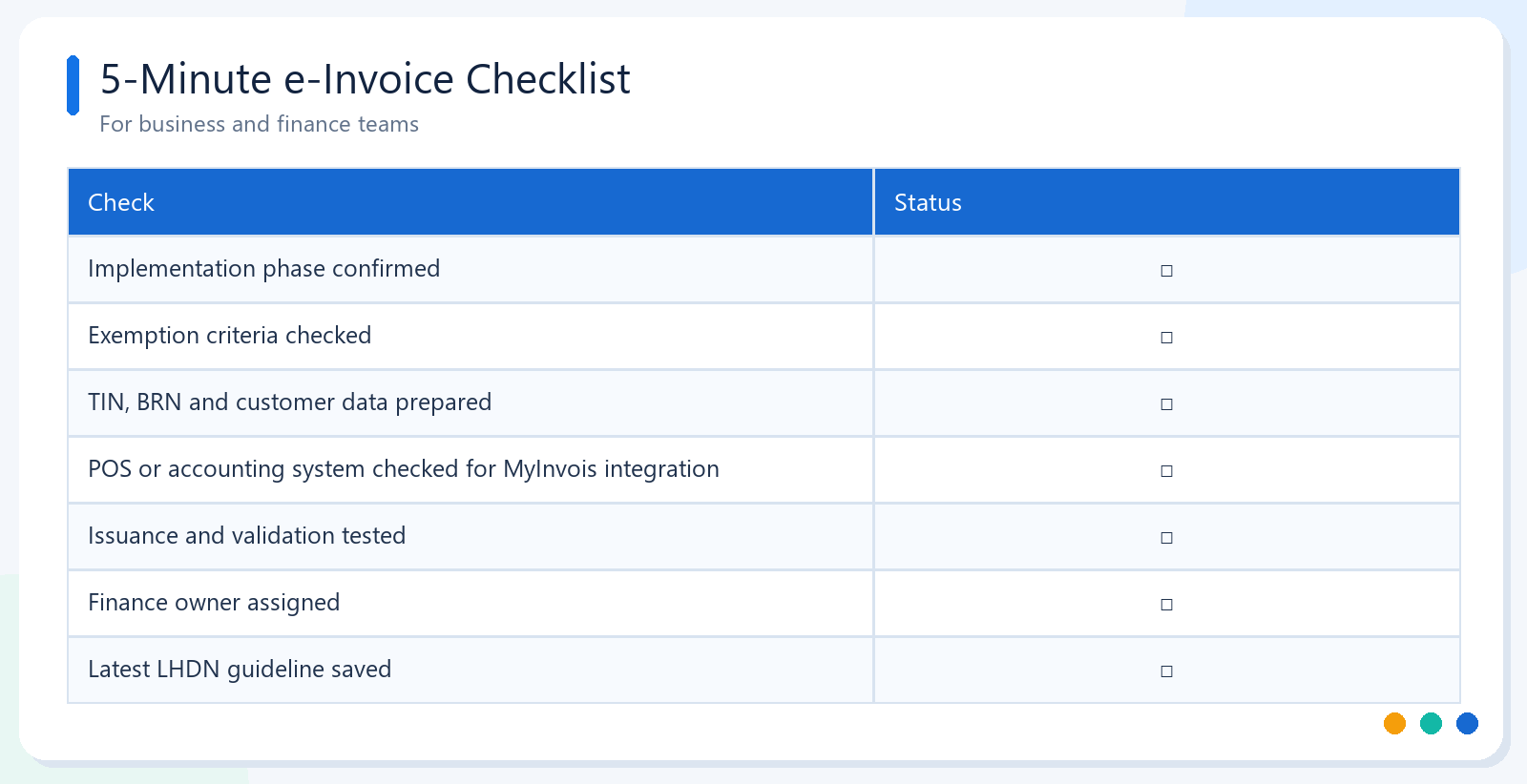
1. Confirm the implementation date. Review the relevant Year of Assessment (YA) revenue and check whether related-company rules affect the exemption.
2. Prepare customer and supplier information, including the Business Registration Number (BRN), Tax Identification Number (TIN), SST Registration Number where applicable, address and contact details.
3. Check the Point-of-Sale (POS), accounting or Enterprise Resource Planning (ERP) system. Ask whether it supports MyInvois, Application Programming Interface (API) integration, batch upload, consolidated e-Invoice and failed-submission tracking.
4. Test a small group of real transactions before a wider rollout.
5. Assign a finance or operations owner to monitor implementation, data quality, failed submissions and policy updates.
5-Minute e-Invoice Checklist
FAQ
How much is the penalty for not issuing e-Invoice?
The stated range is RM200 to RM20,000, with imprisonment of up to six months, or both.
Do businesses below RM1 million need e-Invoice?
Not always. The business must check whether it meets the relevant exemption criteria.
When does e-Invoice start in 2026?
For taxpayers with annual turnover or revenue of up to RM5 million, the relevant dates include 1 January 2026 and 1 July 2026.
Does the transition period mean there is no penalty?
No. The relaxation applies only when the taxpayer follows the permitted arrangements.
Can a POS system connect to MyInvois?
It can, if the POS supports API, batch upload or another compatible integration method.
Call to action
Are you a business owner, partner or finance manager and still unsure whether your company needs to implement e-Invoice? We will give a free assessment:
“What does your business need to do for e-Invoice?”