

What Is AI Cross-Border E-commerce Changing?
The traditional path was linear: choose one marketplace, create a listing, launch ads, answer customers and replenish inventory. When a seller entered another country, much of the work was repeated. AI is changing the operating model into a connected workflow that can run in parallel. It can identify global opportunities, support product decisions, localize content and connect advertising, customer service, inventory and fulfillment.
Amazon’s 2026 trend materials state that more than 98% of surveyed Chinese sellers already use AI tools in their daily business, while 16% have moved from single tools to AI workflows or agents. The competitive question is therefore shifting from “Who uses AI first?” to “Who connects AI to a real operating process?”
For a small team, AI should not replace the owner’s judgment. Its practical value is to turn information scattered across spreadsheets, conversations and individual experience into recommendations that can be tracked, reviewed and improved. The team should retain control of permissions, budgets and final decisions.
For a broader view of cross-border ecommerce SaaS and digitalization, see the cross-border ecommerce SaaS and digitalization article
How Does AI Improve Product Selection?
AI product selection should not only answer “What sells well?” It should also answer “Which customer need is still poorly served?” AI can read changes in search terms, competitor claims, complaints in reviews, return reasons, price bands and differences between marketplaces. It can then form a demand hypothesis for the team to validate against supply, margin and compliance conditions.
A stronger use case is finding a gap inside a mature category. Customers may not simply want an office chair; they may want a support experience that is easier to adjust and better aligned with the body. AI can identify these expressions in reviews and use cases, then convert them into product features, packaging information and content themes.
AI does not replace sample testing. A practical process has three layers: demand signals, product hypotheses and small-batch validation. Only a direction that passes cost, quality, certification, delivery and repeat-purchase checks should move into larger inventory commitments.
How Should Sellers Manage Multilingual Content and Customer Service?
Multilingual content is more than translation. Titles, bullet points, A+ content, image copy, video subtitles and FAQs should be based on one product fact base. Each marketplace may also require different expressions, units, use cases and compliance checks. AI can draft versions at scale, while a human reviews critical terminology, restricted claims and the boundaries of product promises.
Customer service is a feedback signal for content quality. Repeated questions often mean that the listing did not explain an important point clearly enough. When conversations are classified by language, intent, product model and issue type, AI can suggest content updates: which questions should enter the FAQ, which images need clarification and which translations may create confusion.
Intelligent customer service works best for frequent, low-risk and rule-based questions such as delivery tracking, dimensions, usage steps and return policies. Compensation, escalated complaints, product safety, compliance judgments and privacy requests should normally be handed to a human with an audit trail.
How Do Supply Chain and Global Fulfillment Work Together?
When product and content decisions can be copied across markets quickly, inventory must keep pace. Amazon’s Next Generation Global Selling direction connects one-time listing, source-country inbound and global selling. GWD is described as a source-country warehousing and distribution service that connects storage, customs clearance, cross-border transportation, inventory allocation and the Amazon fulfillment network.
The key question is not simply which warehouse is cheapest. Sellers should compare demand signals, replenishment lead time, inventory pools, delivery speed and cash usage for each market. AI can use sales, seasonality, promotions, in-transit inventory and stockout risk to recommend replenishment. Automatic replenishment can connect the recommendation to execution under the applicable program terms.
Fulfillment can also be staged. A new product can test demand through cross-border delivery or limited inventory before moving into a more stable overseas warehouse or FBA network. Multi-channel sellers may also consider MCF. Whichever path is chosen, cost, delivery time, returns, tax and account health should be monitored on the same operating dashboard.
Amazon also disclosed the direction of Amazon Supply Chain Services, which integrates inbound transportation, warehousing and distribution, fulfillment and parcel delivery. Supply chain planning is therefore moving from “find a logistics provider” toward “configure end-to-end capability around a global business objective.”
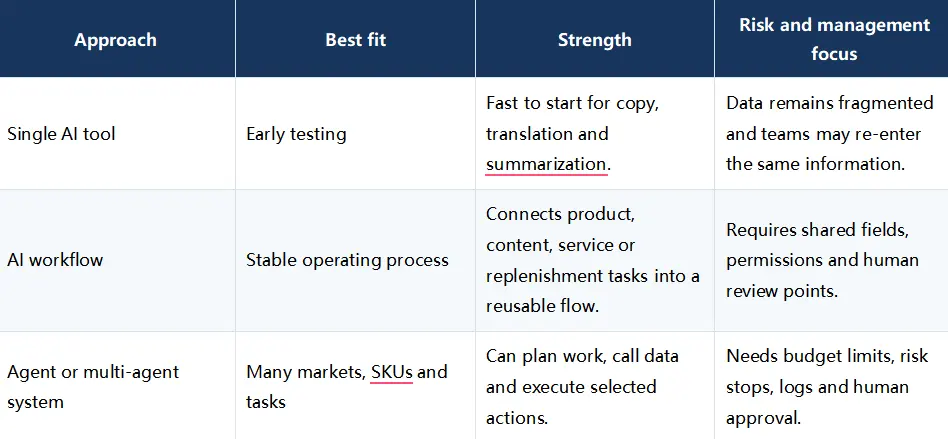
How Should a Business Compare AI Approaches and Investment?
Where Should Sellers Start?
1. Choose one measurable operating problem, such as research time, repeated customer-service questions, stockouts or multilingual content lead time.
2. Build a trusted data baseline covering SKUs, cost, margin, keywords, reviews, inventory, in-transit stock, destination-market compliance and content terminology.
3.Pilot a semi-automated workflow. Let AI draft recommendations, require human approval before execution, and review false positives, missed signals and time saved each week.
4. Feed customer-service feedback back into content and product selection. Turn recurring questions into FAQs, image explanations and product-improvement tasks.
5. Connect inventory and fulfillment. Use demand, in-transit stock and replenishment lead time to generate recommendations, with budget limits and exception alerts.
6. Consider agents only after the workflow is stable. Define which actions are automatic, which require human approval, and how logs, versions and rollback will work.
AI is not a separate technology project. It is a way to make existing operations faster, more measurable and easier to replicate. Starting with one problem that can produce a data loop is usually more useful than purchasing an entire system before the team knows what it needs.
FAQ
Does AI cross-border ecommerce mean buying one tool?
No. A single tool can validate one task, but a stable operating model requires shared data, workflow design, permissions, audit logs and human review.
Can AI replace product managers or buyers?
No. AI can accelerate research and recommendations, while product quality, margin, compliance, samples, delivery and repeat purchase still require business validation.
Is direct translation enough for multilingual content?
No. Sellers also need local terminology, units, search behavior, product facts, image copy, restricted claims and human review for important pages.
Which customer-service cases should be escalated?
Compensation, safety, compliance, privacy requests, serious complaints and high-risk promises should normally be reviewed by a human.
Should sellers place inventory in every country at launch?
Not necessarily. Start with a smaller test through cross-border delivery or limited inventory, then upgrade fulfillment based on demand, delivery time, returns and cash usage.
CTA
If you are planning AI product selection, multilingual content, intelligent customer service, cross-border supply chain or global fulfillment, contact us for a practical system assessment.